

Making a Receive
A comprehensive guide for building an effortless user experience to enable you to receive local fiat from your customers.
Receive Steps & API Overview
A user journey guide for receiving fiat from your customers, including the API reference at each step.
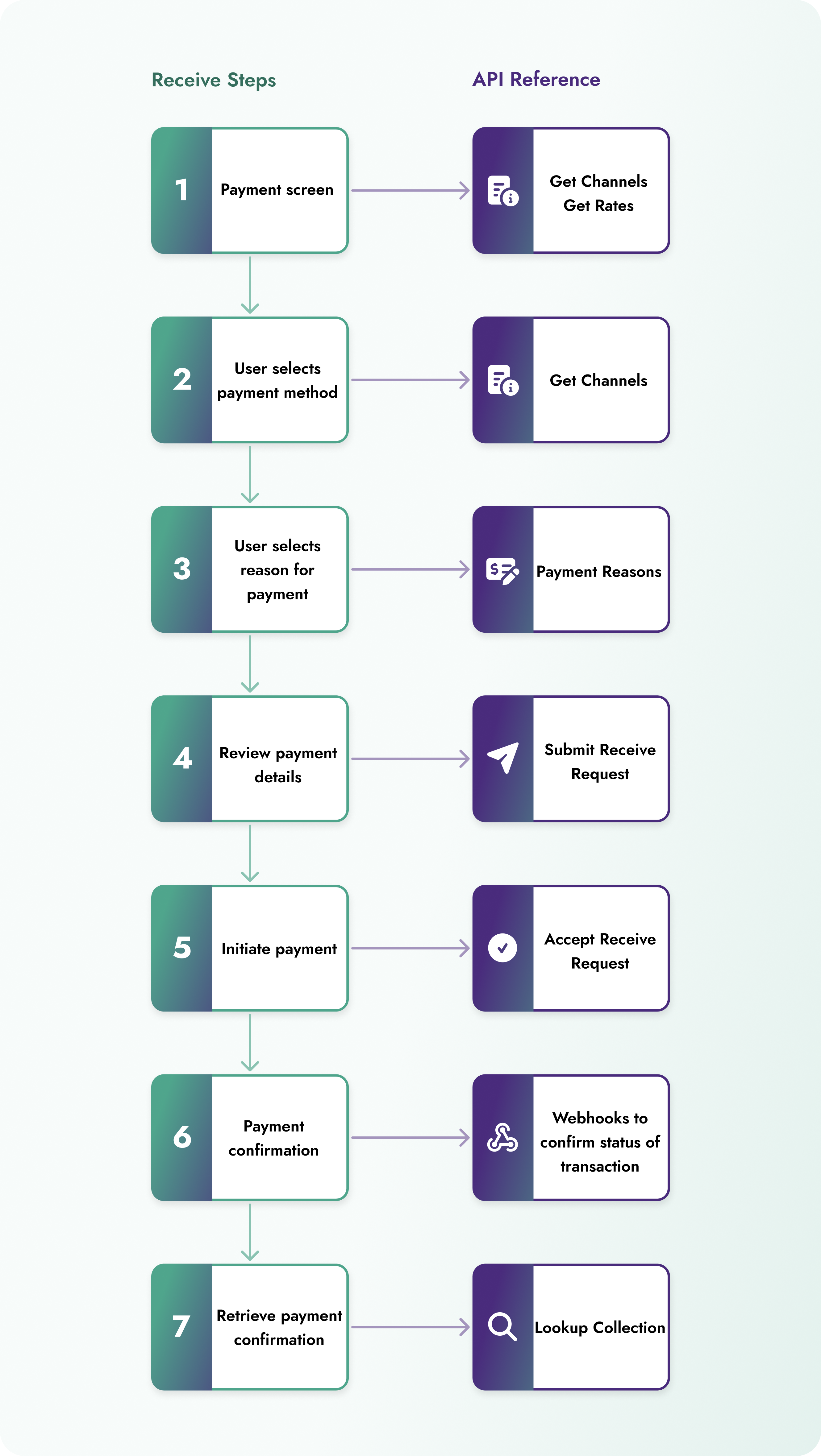
| User journey step | What to show on the UX | What to ask the user for | API reference | What's returned from the API |
|---|---|---|---|---|
| A place for the user to view the amount to pay | n/a |
|
|
| List of payment channels available to them eg: Bank Transfer, Mobile Money, P2P transfer | Their preference of payment method | Get Channels | A list of available payment options for the given country |
| Input fields for customer to enter beneficiary details:
| Please add mobile money details: | Mobile provider = Get Networks | A list of available networks |
| Ask the user the reason for their transaction | To choose from a list of reasons | Reason for sending = Payment Reasons | Pre-defined list of reasons to select. |
| Transaction details including:
| To confirm the payment. | Submit Receive Request | A quote to make the receive transaction |
| Confirmation the transaction is being processed | n/a | Confirmation or rejection of the transaction | |
| Confirmation that payment was successful. | n/a | n/a Webhooks to determine status of transaction | n/a |
| View of transaction details | View transaction details | Lookup Receive | Information about a specific payment |
To get started, open the recipe below:
Receiving in Latin America
Latin American currencies (MXN, BRL, COP, ARS) require a virtual account before a receive can be submitted. Create one via POST /virtual-accounts with the desired fiat currency and an alias. The account starts in a pending state and becomes active asynchronously.
Once active, submit the receive as normal with recipient.alias set to the virtual account alias. The receive response includes a bankInfo object with local bank details to share with the customer so they can initiate the transfer: SPEI/CLABE for MXN, PIX key for BRL, and local bank transfer details for COP and ARS.
Updated 3 months ago